
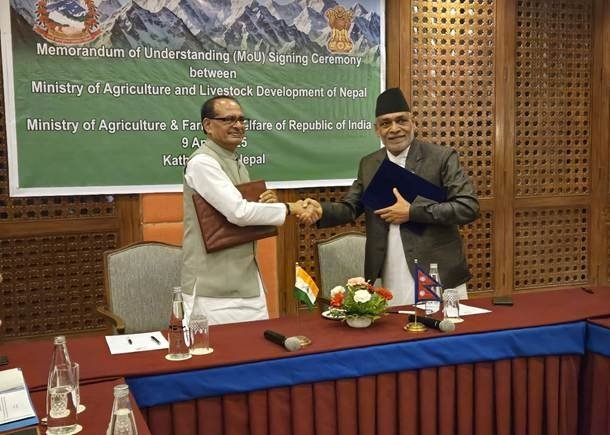
Nepal and India have signed a bilateral Memorandum of Understanding (MoU) to strengthen cooperation in biodiversity conservation and wildlife protection, particularly in cross-border areas.
The agreement was signed in New Delhi in the presence of Nepal’s Minister for Forests and Environment, Madhav Prasad Chaualgain, and India’s Minister for Environment, Forest and Climate Change, Bhupendra Yadav. Nepal’s Ambassador to India, Shankar Prasad Sharma, signed the MoU on behalf of Nepal, while Tanmay Kumar, Secretary of India’s environment ministry, signed for India.
Both countries share extensive ecological corridors and protected areas along their border, which serve as habitats for species such as elephants, rhinos, and tigers. Wildlife frequently moves across the open border, underscoring the need for coordinated conservation strategies.
The MoU seeks to enhance collaboration in managing protected areas, controlling wildlife crime, and regulating poaching and illegal trade. It also outlines provisions for joint research, monitoring, capacity-building of frontline personnel, and awareness programs at the local level.
Under the agreement, the two sides will conduct regular joint patrols, hold coordination meetings in border regions, exchange information on wildlife crime, and share best practices. The MoU also enables both nations to cooperate with the South Asia Wildlife Law Enforcement Network to tackle transnational wildlife offenses.
On Nepal’s side, implementation will involve the Ministry of Forests and Environment and its subordinate bodies, including the Department of Forests and Soil Conservation and the Department of National Parks and Wildlife Conservation, along with provincial authorities.
The agreement will automatically renew every five years unless terminated through diplomatic channels and will undergo review every three years. Any disputes arising during implementation will be resolved through mutual understanding.
Officials from both governments expressed confidence that the partnership would significantly contribute to safeguarding shared ecosystems and preserving biodiversity across the Himalayan region.
More Stories
Holi Celebrated with Fervour Across Tarai Districts
Election Commission Warns Against Code Violations Ahead of HoR Polls; Teachers, Officials Urged to Remain Neutral
Stock Market Rises 0.09%, Turnover Declines from Previous Session